
TGIF Session Recap — 13 March 2026
This week's session was dedicated to demos from the 1st Sprint of the AI Fluency initiative focused on Jira to PR — where engineers built automations to take Jira tickets all the way to a reviewed pull request. Here are the highlights.
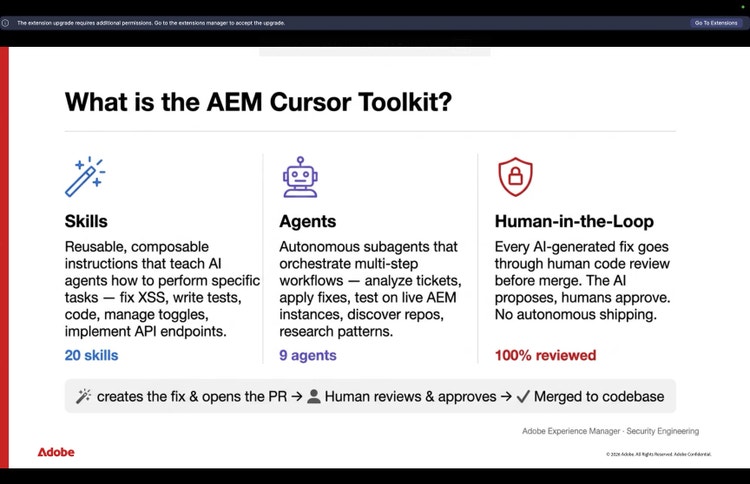
AEM Cursor Toolkit — Skills, Agents, and Autonomous Execution
Presented by: Catalina Dumitru & Ionut Chirvasa
The AEM Cursor Toolkit is a curated library of 20 skills and 9 agents that automates XSS and accessibility Jira tickets end-to-end. The XSS flow reproduces the vulnerability on baseline, writes a failing test, applies the fix, and verifies before opening a PR and updating Jira. An autonomous execution layer — a Jenkins cron job spinning up parallel Docker containers — polls for agent-ready tickets daily and runs the toolkit without human involvement, flagging agent-failed only on failure. Three weeks in: 27 merged PRs across cloud, on-prem, and LTS.
Demo: TGIF-20260313_110318-Meeting Recording - Part1.mp4
TGIF-20260313_110318-Meeting Recording - Part2.mp4
Adobe Reel - https://newsfeeds-stage.adobe.io/reel/65
Q: How do you determine if a Jira ticket is specific enough for the agent to act on, and does it stop to ask for clarification?
A: A human applies the agent-ready label as the quality gate. If reproduction steps are unclear, the agent adapts using its codebase knowledge — in one case it found and fixed a vulnerability despite incorrect steps. If it can't proceed, it marks the ticket with a roadblock label rather than guessing.
Q: Is the toolkit limited to XSS and accessibility, or can it handle general tickets?
A: A generic resolve-jira-ticket skill handles everything else — it routes to XSS or accessibility flows if the pattern matches, or falls back to a general read-plan-fix-test-PR loop. More skills in the repo means broader coverage.
Q: Where should these Docker-based agents be hosted long-term — is there a common platform?
A: Open action item. AEM uses Jenkins workers; others are evaluating Ethos. Vlad committed to a recommendation on a shared platform. Team-level Bedrock subscriptions via AWS cost centres (not personal licences) are the right credential source.
Model-Agnostic Agent and Claude-as-a-Service
Presented by: Adrian-Gabriel Furculita
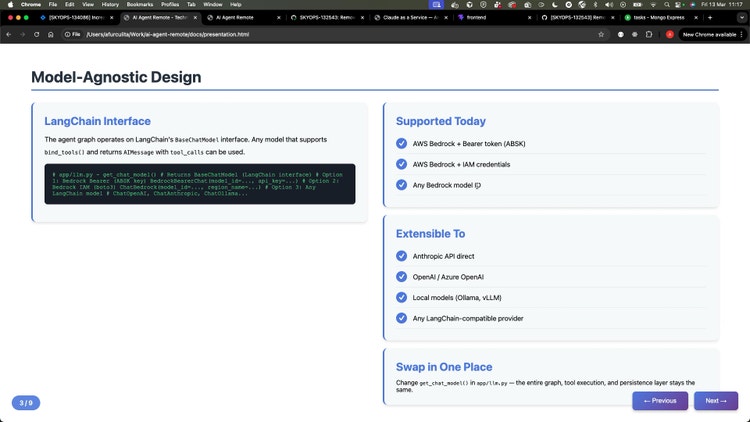
Two complementary approaches to Jira-to-PR automation. The first is a model-agnostic agent loop (LangGraph + FastAPI) with Docker/worktree isolation, interactive and headless modes, and Postgres session persistence — allowing post-PR conversation without checking out the branch locally. The second, Claude-as-a-Service, is a lightweight FastAPI backend that wraps the Claude CLI and picks up a repo's existing CLAUDE.md, skills, and MCPs natively, giving any repository an AI chat interface over its own Claude Code configuration.
Demo: TGIF-20260313_110318-Meeting Recording.mp4
Adobe Reel - https://newsfeeds-stage.adobe.io/reel/66
Q: How do you handle tickets that are too vague — does the agent stop and ask, or does it just proceed?
A: A gating step can route ambiguous tickets to interactive mode and clear tickets to headless mode. Alternatively, let the agent produce a PR regardless and iterate post-PR — often faster than pre-qualifying every ticket.
Q: What is the deployment model for running this in production?
A: Containerised — deploy one instance per service or repo, each with its own build environment. Instances poll Jira, pick up assigned tickets, and produce PRs autonomously.
Q: What is the biggest shared infrastructure need across all teams?
A: A shared Bedrock deployment not tied to personal licenses. The current shared Adobe instance is being discontinued; team-level subscriptions via AWS cost centres with API keys are the right replacement.
Generic Jira-to-PR Workflow with Mid-Process Human Checkpoints
Presented by: Sergiu Coman
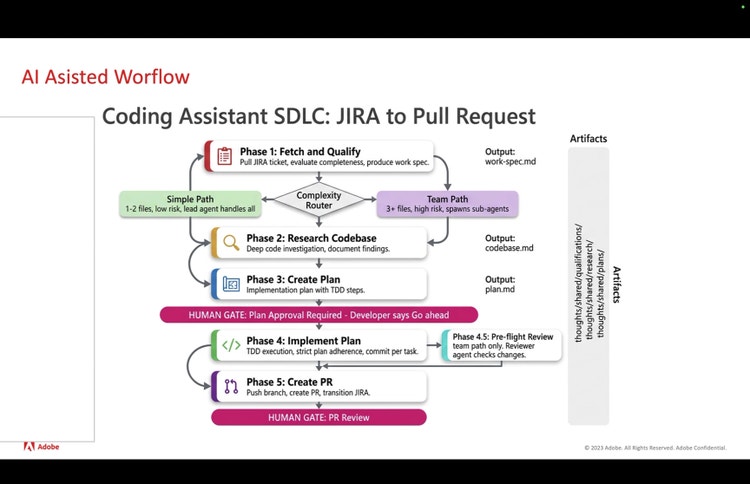
A domain-agnostic Jira-to-PR workflow built around a research-plan-implement sequence, with Git-committed artefacts at each phase and human checkpoints before planning and before writing code. Post-PR, the workflow resumes from Copilot review comments — implementing the valid ones and pausing on ambiguous ones. The next step is headless execution in a container, using Jira comments as the async communication channel.
Demo: TGIF-20260313_110318-Meeting Recording.mp4
Adobe Reel - https://newsfeeds-stage.adobe.io/reel/67
Q: Is this already running in an automated loop, or still under evaluation?
A: Still under evaluation. Next step is headless mode with Jira comments replacing interactive prompts, so it can run in a detached container.
A strong first sprint — with implementations, converging on the same insight: AI-assisted Jira-to-PR is viable today, and the patterns are mature enough to share.
Thanks to Catalina, Ionut, Adrian, and Sergiu for the demos, and to Vlad for driving the sprint.
Have feedback, a demo proposal, or a topic you'd like to see covered? Submit it here.