TGIF Session Recap — 29 May 2026
This session marked our 4th AI Fluency sprint focused on Context Management. Across five demos, teams explored how to structure, preserve, and share the context that AI agents rely on — from project-level documentation all the way to session-to-session handoffs.
These sessions are a key part of our AI transformation — showcasing how we move from basic AI usage through integration and collaboration into the AI fluency zone. Here are the highlights.
Context Tools Compared
Presented by: Daria Runceanu
The AMS RO team evaluated three context management tools — Serena (an MCP server), context mode, and memsearch — each solving a different aspect of AI memory. Context mode filters large tool outputs before they bloat the context window; memsearch preserves conversation memory across sessions and agents.
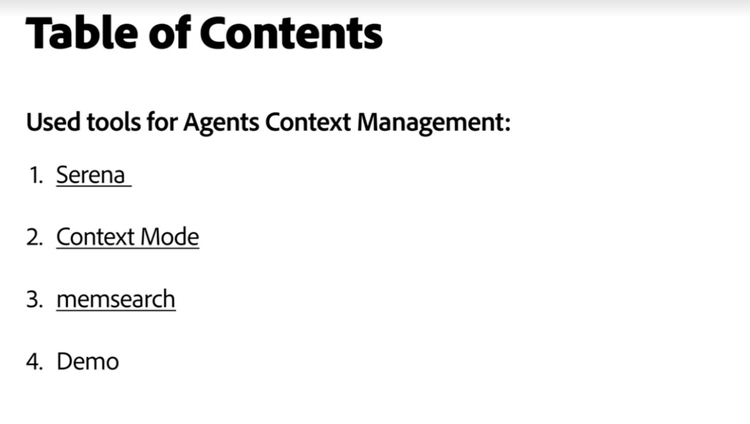
A: Memory files are stored on the local machine. To share them, you commit them to the repository; teammates then pull the latest changes to access the shared context.
A: Context mode and mem search outperformed Serena in practical use. Mem search operates on conversations — to load specs or design documents into memory, you explicitly ask for answers sourced from those files, which then get stored for future sessions.
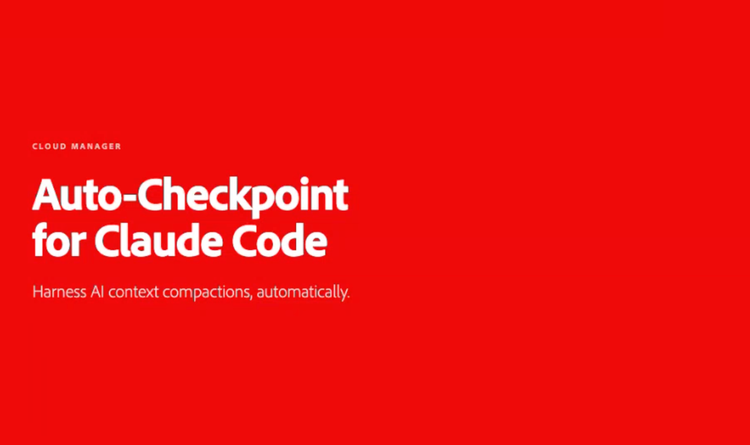
Auto-Checkpoint for Claude Code
Presented by: Delia Constantinescu
CloudManager's complex multi-repo codebase makes context loss during auto-compaction a recurring frustration. A save-checkpoint and resume-checkpoint skill pair automatically synthesizes structured session state — tasks done, decisions made, rejected approaches — into a markdown file, hooked into Claude's post-compact event. The checkpoint fires using a separate non-interactive Claude instance so it does not consume the current session's context. In a real debugging session, this prevented Claude from re-suggesting an approach that had already been rejected after compaction.
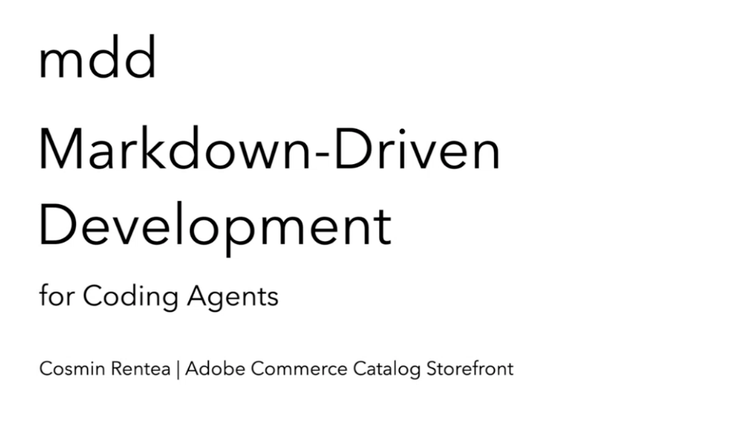
Markdown-Driven Development for Coding Agents
Presented by: Cosmin Rentea
Context bloat — agents loading entire markdown files and consuming hundreds of tokens to extract a few relevant lines — is a growing tax on large-scale engineering. MDD is a Rust-based CLI tool and companion Claude skill that teaches agents to read markdown selectively: first scanning a table of contents, then loading only the relevant section via precise file offsets. In tests across a commerce codebase with hundreds of markdown files, MDD achieved 60–70% token reduction. The tool works across Claude Code and Codex and is published on GitHub.
A: It is a CLI tool that agents can select from a list of available tools, reinforced by a skill and project-level CLAUDE.md instructions. A pre-read hook is also possible but not yet implemented, to keep the tool portable across Claude Code and Codex.
Git Curator System
Presented by: Codrina Mihalache
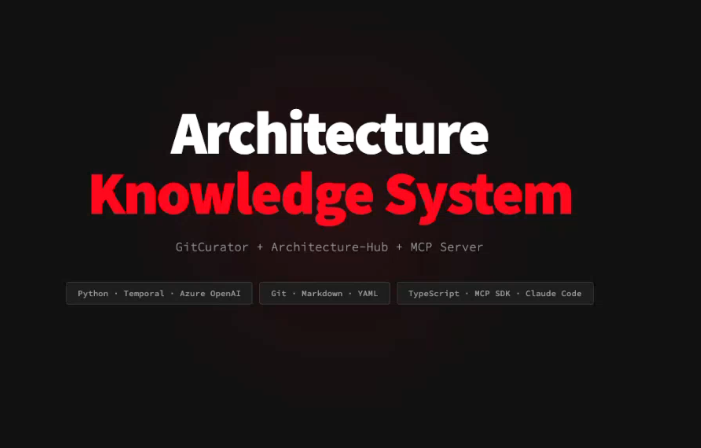
Git Curator is a three-component pipeline that keeps architecture documentation current without manual effort. Running 8 parallel temporal workflows with 17 AI prompts across 15 commerce repositories, it detects service type, performs incremental updates based on commit diffs, and pushes 5 structured markdown files per service to a centralized architecture hub. Engineers query it via an MCP server in Claude Code, getting immediate answers on APIs, dependencies, and deployment. Analysis time: 18 minutes for a new repository, as low as 6 seconds on a cache hit.
Context at Work — Meet Claude Projects
Presented by: Catalin Grigore
Claude Projects creates a persistent, shareable workspace where instructions and knowledge base documents are pre-loaded into every new chat automatically. Three high-value use cases: cross-team bug triage (share the project alongside the Jira ticket — any colleague contributes immediately), long-running incident response (the project becomes the shared memory of the incident across shift changes), and team onboarding (a reusable context every new hire benefits from). Unlike Claude Code — optimized for local execution — Claude Projects is optimized for sharing context across people and time. The two are complementary, not competing.
Five presentations, one theme, and a clear direction: the teams are building toward a future where AI context is structured, preserved, and shared by design. Thanks again to Daria, Delia, Cosmin, Codrina, Catalin for the ideas and working demos, and to Sorin for facilitating. Looking forward to seeing what the next sprint brings.
Have feedback, a demo proposal, or a topic you'd like to see covered? Submit it here.